Designing and Building a Character: From Blender to Unreal Engine
Designing a Character Goes Beyond Aesthetic Choices
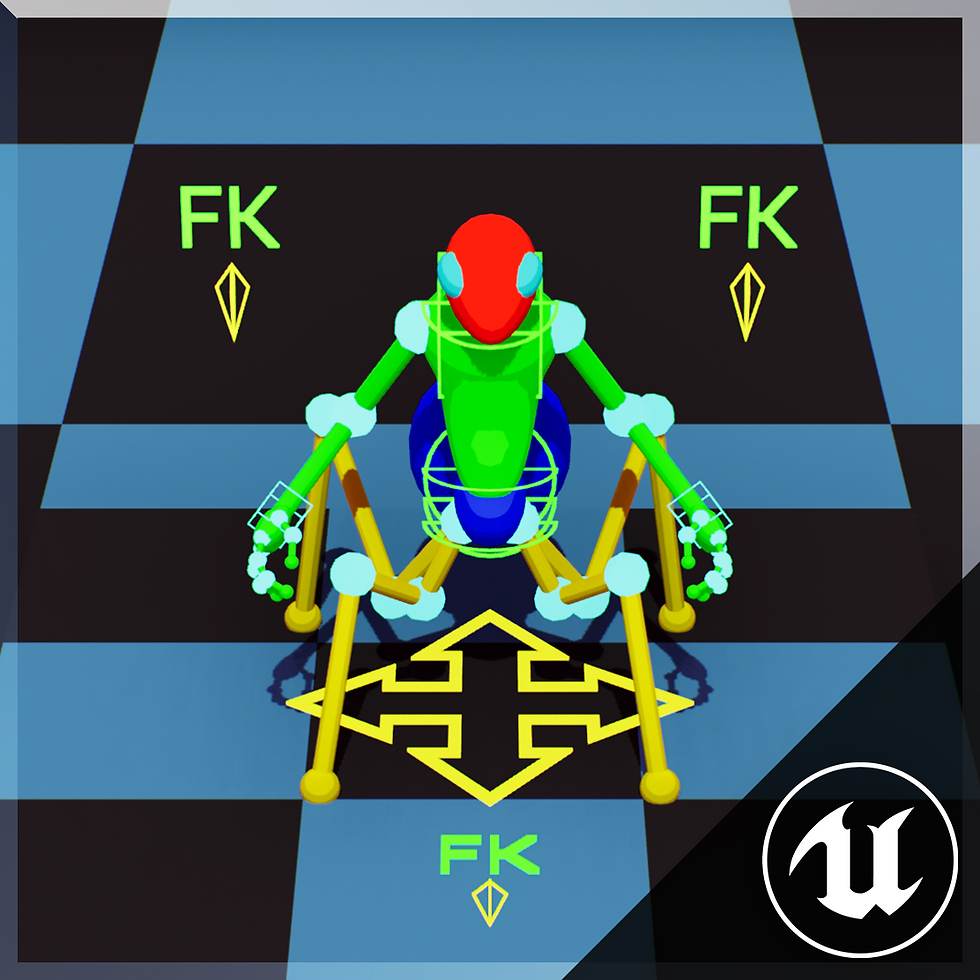
Designing a character is more than just an aesthetic exercise. Every artistic decision inevitably comes with technical constraints to solve, whether it’s ensuring animation consistency, readability in-game, or the character’s ability to interact with surrounding systems. With these challenges in mind, I approached the creation of Ordalie’s very first character, designed from the start to be animated, rigged, and integrated into multiple procedural systems in Unreal Engine.
The goal was not only to produce a functional model, but to establish a robust and scalable pipeline capable of adapting to the future needs of the project.
Planning Before Modeling
Character creation begins with a conceptual phase, placing the character in its game context, especially if it is intended to be playable. Expected interactions such as movement, combat, physics, or environmental contact are defined early to guide technical decisions.
Here, technical considerations take priority. Not at the expense of visual quality, but as its foundation. The character’s design is deliberately influenced by these constraints, with proportions adjusted for better readability, simplified forms to facilitate deformations, and clear volumes to reinforce understanding of in-game movement.
A Mesh Designed as a Tool
To streamline character creation, I developed a Blender tool that allows building a basemesh quickly from simple volumes, connected through a hierarchical system.
The approach focuses on masses and relationships between body parts rather than details. Each volume represents a functional part of the body, helping to map the character’s actions and interactions. This method enables fast iterations and easy adjustments of proportions based on technical needs or in-game testing.
This basemesh remains intentionally schematic. It will never be visible in the final game and serves primarily as a technical support to test, animate, and validate complex systems.

Integration and Corrections in Unreal Engine
Once the model is imported into Unreal Engine, a series of technical corrections is necessary. This includes verifying bone orientations, adding missing bones, standardizing the naming conventions, and adapting the hierarchy to ensure better compatibility with existing systems.
These adjustments may seem minor, but they have a direct impact on the stability and maintainability of the project. This upfront work also enables the creation of a clean, clear, and reusable Control Rig.
A Control Rig Designed to Evolve
The Control Rig is not designed for a single character, but as an adaptable system. Its goal is to integrate new characters without rebuilding the entire rig, while maintaining a coherent workflow and shared tools.
Currently, this system supports several key features, including IK-FK switching, controller creation and hierarchy management, visibility control depending on the active mode, and direct bone manipulation through controllers.
This Control Rig is dedicated exclusively to animation creation and serves as a common foundation for producing consistent and reusable movements.
Procedural Corrections and In-Game Physics
Once the animations are created, other in-game systems take over. Procedural corrections adjust the animations, for example to ensure the feet are properly placed on the ground or to adapt to terrain variations.
A physics system then complements this work by enhancing the animations in real time. It allows movements to adapt to the character’s morphology and environment, improving both the credibility and dynamism of interactions.
A Basemesh as a Universal Foundation
Thanks to the meticulous work done on the skeleton and systems in Unreal Engine, animations created from this basemesh can be shared with the final character. The new model can thus inherit all existing animations without requiring a complete rebuild.
This pipeline allows me to confidently tackle complex challenges related to procedural animation, physics, and content reuse. It will continue to evolve throughout the development of Ordalie and as the project’s needs expand.
👉 To learn more, visit my ArtStation page:
Thank you for taking the time to read, and see you soon for the next update 👋

Comments